A careful reading of responsibility
Full panel script and sources
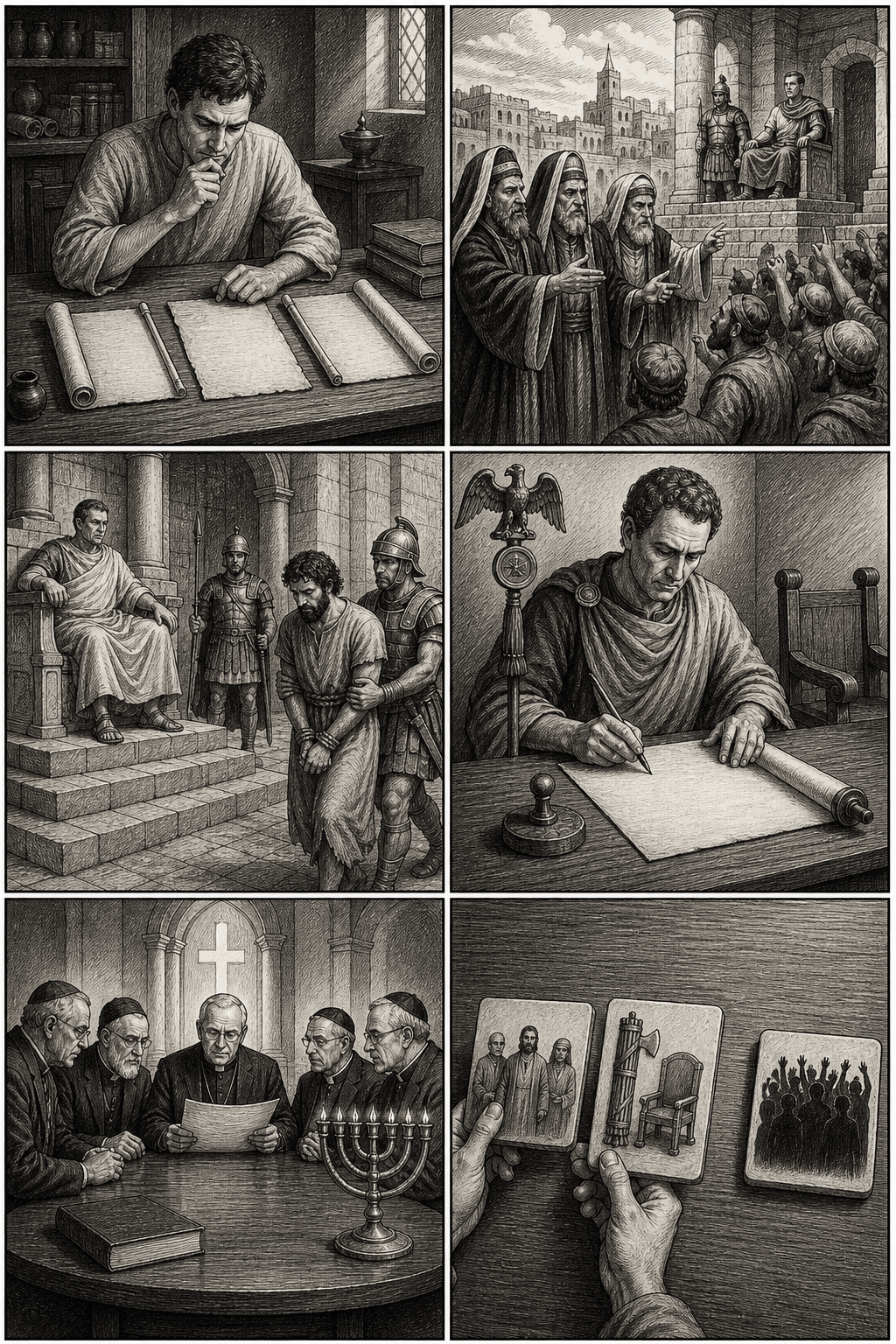
A reader studies three source documents at a desk; the art contains no lettering or readable marks.
The question is about collective responsibility: blaming Jews as a whole, not identifying specific people or institutions in an ancient account.
In ancient Jerusalem, a small group of robed authorities and a separate crowd gesture toward a Roman official’s platform; no group is shown as an entire people.
The supplied Mark 15 summary names Jerusalem leaders, the Sanhedrin, and an incited crowd pressing Pilate for crucifixion.
A Roman official sits on a raised seat while soldiers stand nearby and a bound prisoner is led away; the image is text-free.
In that same supplied summary, Pilate has Jesus flogged and handed over for crucifixion.
A Roman historian writes on a blank scroll beside a plain seal, eagle standard, and official chair; the seal has no letters or pseudo-letters.
Tacitus later connects Jesus’ punishment under Tiberius with Pontius Pilate and gives no role to Jews collectively.
A council chamber with clergy reviewing an unmarked document while a menorah-shaped lamp and cross-shaped architecture appear respectfully in the background.
Nostra aetate rejects charging Jesus’ passion to all Jews then alive or to Jews today.
A reader sorts exactly three symbolic tiles: one with a few individual figures, one with Roman fasces and a chair, and one dark crowd silhouette placed apart.
A careful conclusion can discuss some alleged participants and central Roman authority in the supplied accounts, but not collective Jewish guilt.
What the evidence supports
No: the supplied evidence does not support blaming Jews collectively for Jesus’ death. It supports, at most, roles for some specific authorities or participants, with Pilate identified as the Roman official authorizing or connected with the punishment.
This conclusion is limited to the supplied dossier, which includes summarized source material rather than verified quotations. It distinguishes historical agency in specific accounts from collective blame against Jews as a people.
Mark 15, as summarized in the dossier, supports some involvement by Jerusalem chief priests, elders, scribes, the Sanhedrin, and an incited crowd.
Nostra aetate acknowledges that some Jewish authorities and those who followed their lead pressed for Jesus’ death.
The strongest response
Mark 15 does not support blaming Jews collectively because the supplied summary names specific leaders and a crowd while depicting Pilate as the Roman official who has Jesus flogged and handed over.
Tacitus identifies Pontius Pilate as the official connected with Jesus’ punishment and gives no role to Jews collectively.
Nostra aetate rejects charging Jesus’ passion against all Jews then alive or Jews today.
What remains open
The exact wording and context of Mark 15 should be verified before quotation.
Tacitus’ later reference should be weighed against Gospel narratives and other ancient sources not supplied here.
The legal authority of Jewish institutions versus Roman officials in capital cases in Judea around 30 CE remains an open historical question in this dossier.
Source notes
Primary records and original investigations are linked directly. Notes describe the source's role and limits; they do not ask you to accept its conclusions without reading.
- CL-147FC5F6-01
Bible Gateway · OpenAI web-search result; primary religious text
Mark 15 ↗
Canonical Christian Gospel narrative presenting a theological and narrative account of Jesus before Pilate and the crucifixion. Locator: OpenAI web-search result; Mark 15:1-15, 15:24-32 Limitations: Confessional narrative source rather than a neutral court record. Does not establish that all Jews in Judea, let alone Jews collectively, participated in or approved the execution. This is an AI-generated summary returned with OpenAI web search, not the source's original text or a verified quotation. Open the original page and verify its exact wording, date, publisher, mandate, and surrounding context before relying on it.
- CL-147FC5F6-02
Dickinson College Commentaries · OpenAI web-search result; primary Roman historical record with academic commentary
Tacitus, Annals 15.44 ↗
Roman senatorial historiography describing Nero’s persecution of Christians and the origin of the Christian name. Locator: OpenAI web-search result; Annals 15.44, commentary on Pontium Pilatum Limitations: Written decades after the crucifixion and focused on Nero’s Rome, not a detailed Judean trial record. Uses Roman terminology and perspective; the commentary notes an anachronistic title for Pilate. This is an AI-generated summary returned with OpenAI web search, not the source's original text or a verified quotation. Open the original page and verify its exact wording, date, publisher, mandate, and surrounding context before relying on it.
- CL-147FC5F6-03
Holy See Press Office / Vatican · OpenAI web-search result; modern religious authority; party submission
Nostra aetate ↗
Official Second Vatican Council declaration on the Catholic Church’s relation to non-Christian religions, including Judaism. Locator: OpenAI web-search result; Section 4 Limitations: Confessional Catholic teaching, not an independent ancient historical record. Addresses theological and pastoral responsibility more than reconstructing the precise events of Roman Judea. This is an AI-generated summary returned with OpenAI web search, not the source's original text or a verified quotation. Open the original page and verify its exact wording, date, publisher, mandate, and surrounding context before relying on it.