A longer history
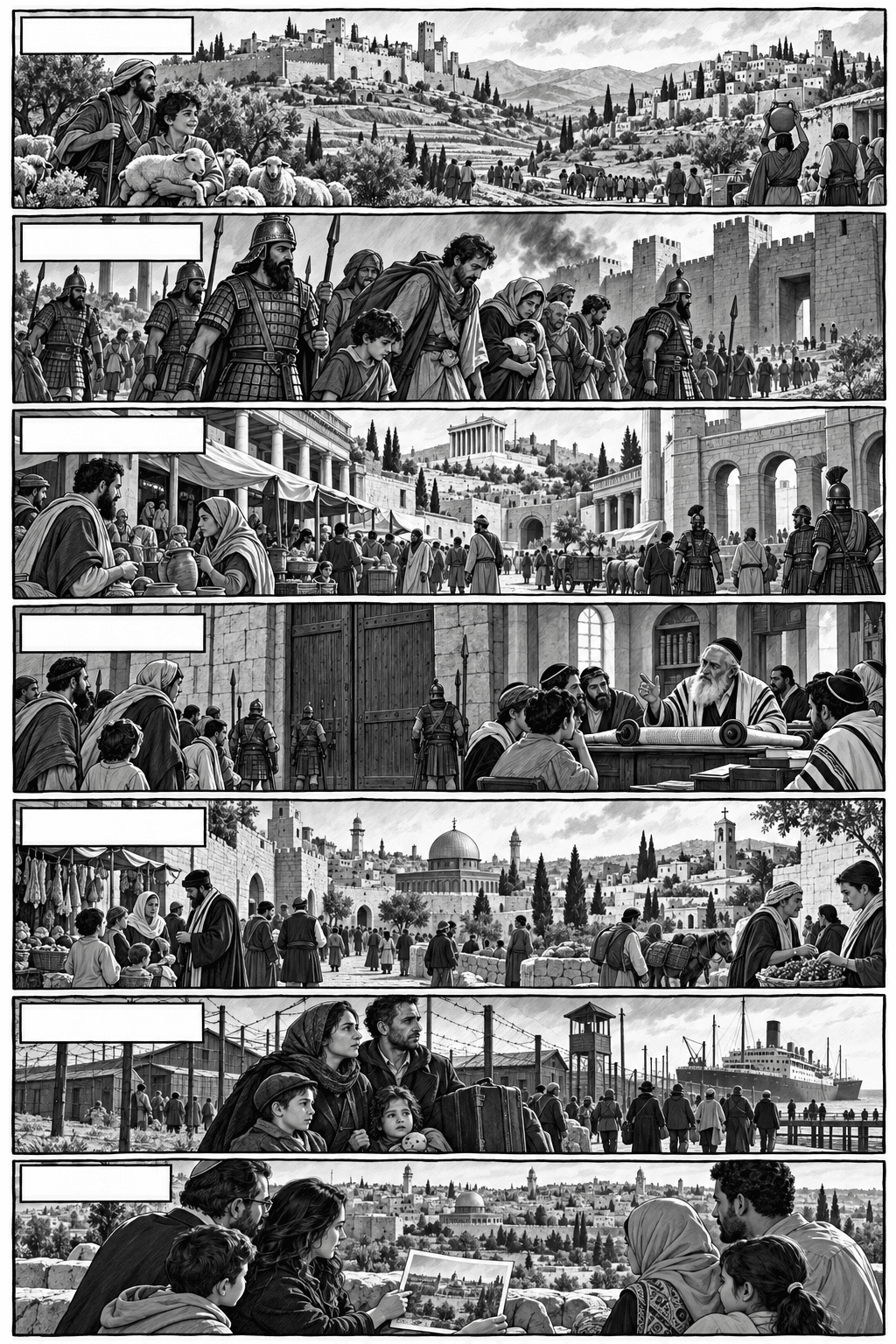
- Ancient kingdoms of Israel and Judah arose here. A31Israel & Judah
- Assyrian and Babylonian conquest brought deportations. A31, A32Deportations
- Persian, Hellenistic, and Roman powers followed. A32Empires changed
- Rome barred Jews from Jerusalem after revolt. A34Rome bars Jerusalem
- Jewish communities remained in Galilee and elsewhere. A33, A35Jewish life endured
- The Holocaust murdered six million Jews. A36The Holocaust
- Survivors sought refuge after World War II. A37Postwar refuge
Full panel script and sources
Local residents continue daily life as Persian, Hellenistic, and Roman authorities change.
The region passed through successive imperial rule. Conquest changed political authority; it did not make the population or its history disappear.
Roman soldiers close Jerusalem's gate to Jewish families after revolt.
After the Bar Kokhba revolt, Rome barred Jews from Jerusalem and displaced many people. That was not the expulsion of every Jew from the region.
Different places, different arrangements
These short labels do not capture every authority, right, or change on the ground. Follow the notes and sources below.
The legal question today
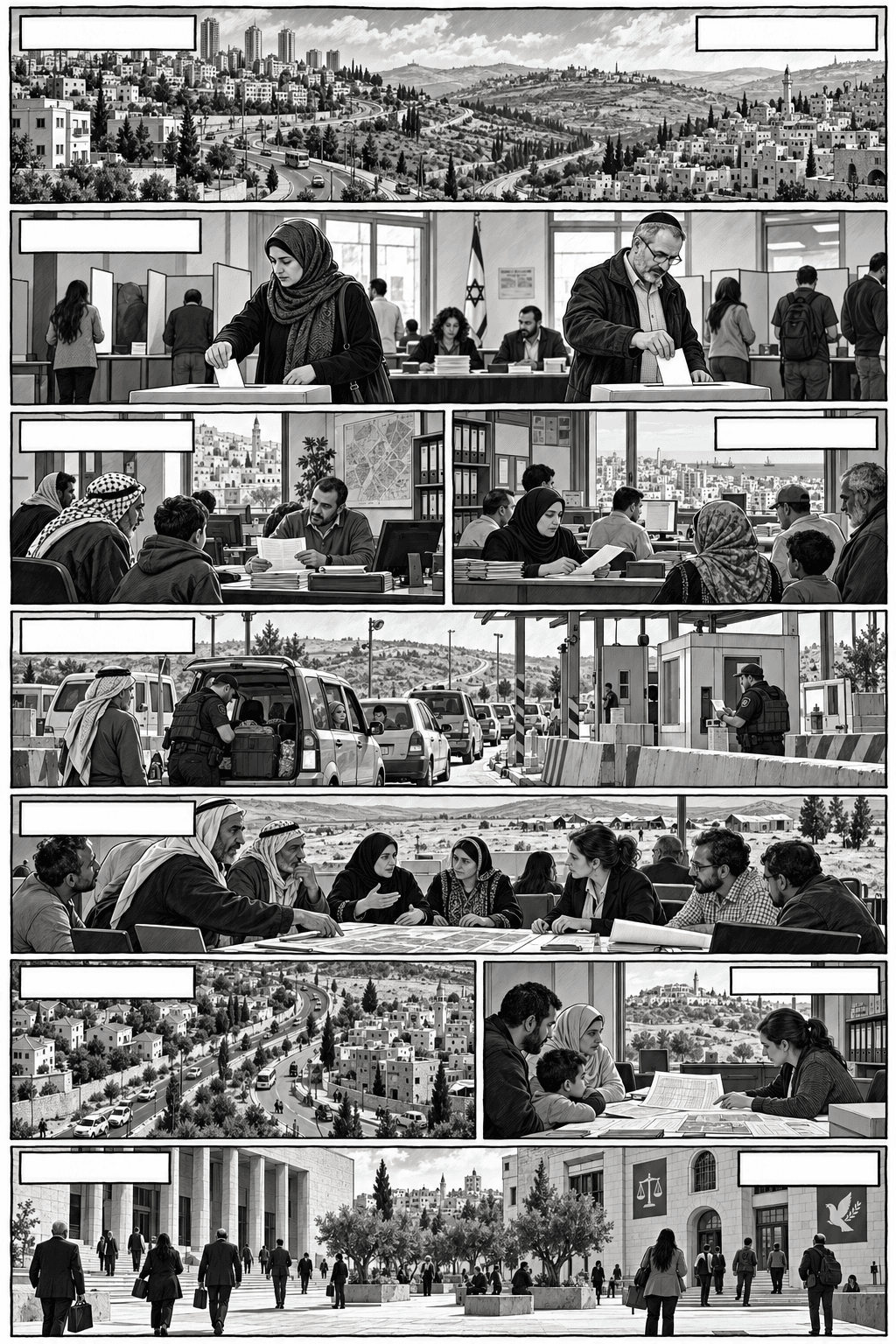
- Shared region, different authorities. A2, A7Shared region
- Legal status varies by location. A2, A7Different rules
- Arab and Jewish citizens vote for Knesset. A1Citizens vote
- PA civil powers: Areas A and B. A7, A23PA civil powers
- Gaza's governance is distinct and changing. A8, A13Gaza governance
- UN: Gaza transition had not begun by 24 Sep 2026. A13Transition status
- One checkpoint: security rationale and cost. A14, A15Checkpoint
- Rights, national status, and outcomes differ. A27, A28National status
- ICJ: near-complete separation in West Bank and East Jerusalem. A2ICJ: separation
- Land policy appears in apartheid analyses. A2, A3, A5Land policy
- ICJ found systemic discrimination and Article 3 breach. A2ICJ finding
- HRW and Amnesty found apartheid; ICJ did not classify it. A2, A3, A5NGO findings
Full panel script and sources
A close view shows two communities sharing one region under different legal arrangements.
Residents' legal status and the authority governing daily life differ by place. Palestinian residents in the occupied territory are not Israeli citizens; the rights question extends beyond the Knesset vote.
A polling place shows an Arab Israeli woman and a Jewish Israeli man voting in the same election.
Arab and Jewish citizens have the same formal individual civil and political rights, including the Knesset vote. The Nation-State Basic Law reserves national self-determination to Jews; substantive inequalities remain.
The UN's dated Gaza transition status appears in a separate narration box beside the administrative office.
The UN reported on 24 September 2026 that the planned technocratic administration had not entered Gaza. This is a dated snapshot; governance arrangements can change.
Different roads connect Israeli settlements and Palestinian communities across a West Bank landscape.
The ICJ found near-complete separation between settler and Palestinian communities in parts of the West Bank and East Jerusalem, alongside systemic discrimination.
A judicial building with people entering, shown as an institution separate from the rights group.
The ICJ found systemic discrimination and an Article 3 treaty breach in the occupied territory. That is the Court's holding.
What the evidence supports
Arab and Jewish citizens of Israel have the same formal individual civil and political rights as citizens, including Knesset voting rights; the Supreme Court has said minority citizens' equality remains protected. Israel's Nation-State Basic Law nevertheless reserves national self-determination to the Jewish people. That citizen-rights question is distinct from the rights of Palestinians under occupation. Human Rights Watch and Amnesty concluded apartheid; the ICJ found systemic discrimination and an Article 3 treaty breach without separately classifying it as the crime of apartheid.
The ICJ found systemic discrimination against Palestinians in the occupied territory, a near-complete separation between settler and Palestinian communities in parts of the West Bank and East Jerusalem, and a breach of Article 3 of the racial-discrimination convention.
Human Rights Watch and Amnesty separately concluded that Israeli authorities committed apartheid. Their methods and geographic scope differ, and their reports are not court judgments.
OCHA documents internal West Bank movement obstacles and reported effects on work, education, health care, and family life. The inventory is evidence to examine; it does not by itself resolve intent or legality.
The strongest response
Arab citizens have the same formal individual civil and political rights as Jewish citizens under Israeli citizenship law, including the vote and eligibility to serve in the Knesset. Israel's Supreme Court upheld the Nation-State Basic Law while saying it does not remove minority citizens' individual equality protections. The law still gives Jewish national self-determination a distinct constitutional status, and substantive inequalities persist. None of this settles the rights of Palestinians under occupation.
Oslo assigns ordinary civil powers to the Palestinian Authority in Areas A and B, while Israel retains specified security responsibilities. That division does not mean Israel issues routine building permits in A/B, or that it has no other duties.
Israeli citizen entry is restricted differently by place. Government guidance says Israeli citizens and residents are barred from Gaza and Area A; a Knesset hearing records exceptions and differing Area A enforcement. A 2020 Area B restriction was time-limited, and the cited 2022 Gaza procedure describes case-specific permits. Permission to enter is not the same as a right to reside or work there.
Israel describes checkpoints and crossings as security measures against weapons and attacks. A stated security purpose matters, but the location, duration, alternatives, and civilian effects of each measure still need testing.
What remains open
The Rome Statute crime requires an institutionalized regime of systematic oppression and domination, inhumane acts, and intent to maintain that regime. Do the evidence and policies satisfy each element?
The ICJ found an Article 3 breach but did not decide whether the conduct was apartheid or racial segregation. Human Rights Watch and Amnesty reach a more specific conclusion in their investigations.
Gaza's transitional governance is changing. The description above is dated to the UN report of 24 September 2026 and must be rechecked before publication.
A/B/C, East Jerusalem, Gaza, and Israel have different legal and political arrangements. Treating them as one identical system hides facts that matter to the analysis.
Comparisons and their limits
South Africa under apartheid (1948–1994) is the clearest established example: law enforced racial classification, political exclusion, segregation, and forced removals. The ICJ also addressed South Africa's apartheid administration in present-day Namibia and held its continued presence there unlawful. The limit: Namibia was then administered by South Africa, not an independent comparator, and the historical system differs from Israel/Palestine.
Myanmar's treatment of the Rohingya is a named modern comparison. Human Rights Watch concluded that confinement, movement restrictions, and denial of rights amounted to apartheid and persecution. The limit: this is an NGO legal assessment, not an international court's final finding; the Rohingya's mass statelessness and internment are distinct facts.
These examples show how the label has been used and, in South Africa's case, attached to a historically established system. They do not prove equivalence. Compare the legal status of each population, political rights, governing authority, segregation, inhumane acts, and evidence of intent; apply the same test to Israel and Palestinians in each territory.
Who made these findings?
Read the institution and the record
A court ruling, an advisory opinion, an investigative report, a treaty, and a government response have different roles. The notes identify which one you are reading and what it did not decide.
Source notes
Primary records and original investigations are linked directly. Notes describe the source's role and limits; they do not ask you to accept its conclusions without reading.
- A1
Knesset · Official election information
The electoral system in Israel ↗
Israeli citizens aged 18 and over may vote in Knesset elections. This does not describe the rights of noncitizens in the occupied territory.
- A2
International Court of Justice · Advisory opinion
ICJ advisory opinion on the Occupied Palestinian Territory (2024), paragraphs 196–229 ↗
Found systemic discrimination and a breach of Article 3 of the Racial Discrimination Convention in the occupied territory. The Court did not separately decide the Rome Statute crime of apartheid.
- A3
Human Rights Watch · Original NGO investigation
A Threshold Crossed (2021) ↗
Concluded that Israeli authorities committed crimes of apartheid and persecution in the occupied Palestinian territory. This is an NGO finding, not a court judgment.
- A4
International Court of Justice, separate opinion · Judicial opinion
Judge Nolte's separate opinion (2024), paragraphs 8–9 ↗
Explains the view that the majority did not decide whether the Article 3 breach was apartheid or racial segregation. It is a separate opinion, read with the Court's majority opinion.
- A5
Amnesty International · Original NGO investigation
Israel's Apartheid Against Palestinians (2022) ↗
Applied a broad territorial analysis and concluded that apartheid was being committed. This is an NGO finding, not a court judgment.
- A6
International Criminal Court treaty text · Treaty definition
Rome Statute, Article 7(2)(h) ↗
Defines the crime of apartheid through inhumane acts within an institutionalized regime of systematic oppression and domination, with intent to maintain that regime.
- A7
Israel and Palestine Liberation Organization · Interim agreement
Israeli-Palestinian Interim Agreement (Oslo II), 1995 ↗
Allocates Palestinian Authority civil and security powers and Israeli security responsibilities in Areas A, B, and C. It is not a grant of full sovereignty or a complete account of current control.
- A8
Office of the UN Special Coordinator for the Middle East Peace Process · Current institutional report
UN Special Coordinator report to the Ad Hoc Liaison Committee, September 2026 ↗
As of 24 September 2026, reported that Gaza's transitional arrangements had been established but the National Committee for the Administration of Gaza had not yet entered Gaza to assume governance functions. Recheck before publication.
- A9
United Nations · Treaty text
International Covenant on Civil and Political Rights, Articles 2, 25 and 26 ↗
Provides for citizens' political participation and protects all persons under jurisdiction against discrimination.
- A12
Palestinian Central Elections Commission · Official election record
Palestinian Legislative Council election results (2006) ↗
The election was Palestinian-wide, including Gaza and the West Bank; it was not a Gaza-only referendum.
- A13
United Nations · Historical account
UN account of the post-2007 Gaza closure regime ↗
Describes the Hamas takeover in 2007 and the tightening of restrictions after the armed conflict. Some restrictions predated 2006.
- A14
Israeli Ministry of Defense · Government statement
Crossing Points Authority ↗
Israel's stated security purpose for crossing inspections. A stated rationale does not establish that every measure is necessary or effective.
- A15
UN Office for the Coordination of Humanitarian Affairs · Movement-obstacle inventory
Movement and access in the West Bank (April 2026) ↗
Documents internal West Bank movement obstacles and reported effects on Palestinian civilians. These are distinct from crossings between Gaza or the West Bank and Israel.
- A17
International Court of Justice · Advisory opinion
Western Sahara advisory opinion (1975) ↗
Addressed historical ties and Sahrawi self-determination. It was not an apartheid case and is not a direct factual equivalent to Israel/Palestine.
- A18
European Commission of Human Rights / European Court of Human Rights record · Human-rights case record
Cyprus v. Turkey, European Commission of Human Rights record ↗
Cyprus alleged apartheid and racial discrimination in northern Cyprus; the record discusses discriminatory treatment. This was not an ICJ ruling, and allegation must be distinguished from holding.
- A19
International Court of Justice · Advisory opinion
Legal Consequences for States of the Continued Presence of South Africa in Namibia (1971) ↗
Held South Africa's continued presence in Namibia unlawful and addressed apartheid-era rule. This is a historical case, not a present-day territorial comparator.
- A20
International Court of Justice · Racial-discrimination treaty cases
Armenia v. Azerbaijan case record ↗
Both states brought cases under the racial-discrimination convention. These are not ICJ apartheid findings; each case has its own facts and procedural status.
- A21
Government Press Office · Government guidance
Government visitor guidance on entry to Gaza and Area A ↗
States that Israeli citizens and residents are barred from Gaza and Area A. A separate Knesset hearing records exceptions and differing enforcement practice in Area A; guidance and implementation should be distinguished.
- A22
UN Office for the Coordination of Humanitarian Affairs · Dated movement report
OCHA COVID-19 emergency report, 3–17 November 2020 ↗
Records a time-limited Area B entry order during this period; it does not establish a current blanket ban on Israeli citizens entering Area B.
- A23
Government of Israel · Government account
Israeli government overview of the Oslo arrangements ↗
Summarizes Palestinian Authority planning powers in Areas A and B and Israeli planning jurisdiction in Area C. The Oslo agreement is the original allocation source.
- A24
Knesset Foreign Affairs and Defense Committee subcommittee · Hearing record
Knesset subcommittee record on Israeli entry into Area A (25 December 2025) ↗
An IDF official said the Area A order applies to all Israeli citizens, while enforcement and political instructions sometimes differ. The record highlights the distinction between a written rule and actual exceptions or enforcement.
- A25
Coordination of Government Activities in the Territories · Dated movement procedure
Status of authorizations for movement between Israel, the West Bank, and Gaza (2022) ↗
Describes permit requirements and case-specific exceptions, including Israeli entry into Gaza. It is dated 2022 and does not establish current practice in 2026.
- A26
International Court of Justice · Racial-discrimination treaty case
Azerbaijan v. Armenia case record ↗
Azerbaijan's reciprocal case under the racial-discrimination convention. It is not an ICJ apartheid finding.
- A27
Knesset · Constitutional Basic Law
Basic Law: Israel as the Nation-State of the Jewish People (2018) ↗
States that national self-determination in Israel is unique to the Jewish people, while also providing for Hebrew's state-language status, Arabic's special status, and Jewish settlement as a national value. This is a distinction in national/collective status; it does not say Arab citizens lack individual civil or political rights.
- A28
Supreme Court of Israel, as High Court of Justice · Constitutional judgment, described in Israel's ICCPR report
HCJ 5555/18, Hason v. Knesset (8 July 2021) ↗
The Court rejected petitions to invalidate the Nation-State Basic Law, holding that it should be read with Israel's other Basic Laws and does not derogate from the state's democratic identity or minority citizens' individual equality. This is the Court's interpretation; critics argue the law's national-identity provisions still mark unequal collective status.
- A29
United Nations General Assembly · Historical resolution
Apartheid policies of the Government of South Africa, UN General Assembly Resolution 2923 (XXVII) (1972) ↗
Condemns South Africa's apartheid policies as a crime against humanity and references forced removals and Bantustans. South Africa is the central, historically recognized national system of apartheid.
- A30
Human Rights Watch · Original NGO investigation
An Open Prison without End: Myanmar's Mass Detention of Rohingya in Rakhine State (2020) ↗
Concluded that Myanmar's treatment of Rohingya amounted to crimes against humanity including apartheid and persecution. This is a documented NGO legal assessment, not a final judgment by an international court; the Rohingya case is a modern comparison with distinct citizenship, displacement, and conflict facts.
- A31
The Metropolitan Museum of Art · Historical essay
Cyrus and the Judean Diaspora ↗
Describes the ancient kingdoms of Israel and Judah, Assyrian and Babylonian conquest and deportation, and evidence of Judean communities in Babylonia. It also notes that some exiles returned while many stayed in diaspora.
- A32
The Metropolitan Museum of Art · Historical timeline
The Eastern Mediterranean and Syria, 1000 B.C.–1 A.D. ↗
Summarizes the emergence of local kingdoms and successive Assyrian, Babylonian, Hellenistic, and Roman power in the region, including documented deportations. Ancient chronology is condensed for the comic.
- A33
Cambridge University Press, The Cambridge History of Judaism · Scholarly history
Political, social, and economic life in the Land of Israel, 66–c. 235 ↗
Explains the transition to direct Roman rule after the First Jewish Revolt and notes substantial Jewish population remained in Judea before the later Bar Kokhba revolt. Roman-period demographic effects are complex and debated.
- A34
The Metropolitan Museum of Art · Historical exhibition essay
Exhibition Galleries: The World between Empires ↗
Describes the two major Jewish revolts against Rome and the Roman expulsion of Jews from Jerusalem after the Bar Kokhba revolt. That local exclusion was not the expulsion of every Jew from the region.
- A35
The Metropolitan Museum of Art · Historical essay
Judaism During the Byzantine Period ↗
Discusses Jewish communities in Palestine under Byzantine and early Islamic rule and the growth of Jewish diaspora centers. Successive regimes and local conditions varied over time.
- A36
United States Holocaust Memorial Museum · Holocaust historical reference
How Many People did the Nazis Murder? ↗
Documents that Nazi Germany and its allies and collaborators murdered six million Jews during the Holocaust, alongside persecution and murder of millions of other victims.
- A37
United States Holocaust Memorial Museum · Postwar refugee history
Holocaust Survivors and the Establishment of the State of Israel ↗
Describes Jewish displaced persons after the Holocaust, restrictive immigration policies, and many survivors' efforts to reach Mandatory Palestine.
- B1
International Court of Justice · Institutional description
The International Court of Justice ↗
Explains the Court's judicial role and structure. The ICJ is distinct from the Human Rights Council and its Commission of Inquiry.
- B2
UN Human Rights Council · Resolution and mandate
Human Rights Council resolution S-30/1 and Commission mandate ↗
Records the creation and mandate of the continuing Commission of Inquiry. The Council is an intergovernmental body; the Commission is investigative.
- B4
Government of Israel, Geneva mission · Party position
Israel's objection to the Commission of Inquiry mandate (2025) ↗
Israel argues that the continuing mandate singles it out and is too broad. This is Israel's objection, not an independent finding of bias.
- B5
Government of Israel · Party position
Israel's statement on the ICJ annual report (2025) ↗
Criticizes political use of ICJ proceedings and interim measures. It presents Israel's argument, not an independent conclusion about the Court.
- B6
International Court of Justice · Court opinion and response to objections
ICJ advisory opinion on the Occupied Palestinian Territory (2024) ↗
Records objections about the request's framing and the Court's reasoning for proceeding. Read alongside the separate dissent and Israel's position.
- B7
International Court of Justice, dissenting opinion · Judicial dissent
Vice-President Sebutinde's dissent (2024) ↗
Argues that the request and record were one-sided and insufficiently addressed competing claims. A dissent, not the Court's majority holding.