One land, two histories, several questions
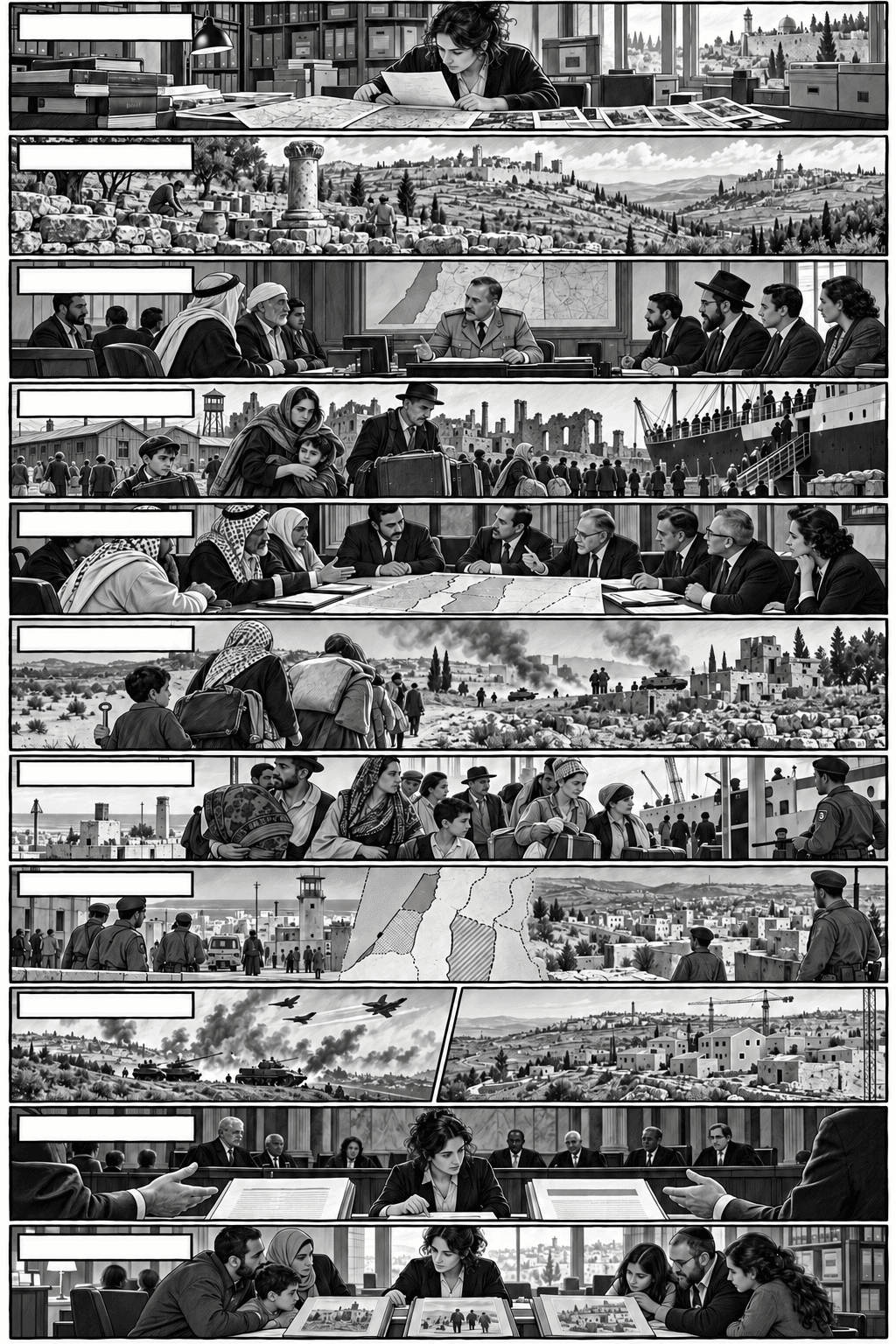
- What history does the colonialism claim describe?The question
- Israel and Judah were ancient kingdoms.Ancient ties
- Britain governed under the Mandate.British Mandate
- After World War II, survivors sought refuge.Postwar refuge
- A 1947 UN plan proposed partition.Partition plan
- War brought mass Palestinian displacement.1948 war
- Some fled; others were expelled or pressured to leave.Varied departures
- Egypt in Gaza; Jordan in West Bank.Regional rule
- Israel struck first in June 1967.1967 war
- ICJ found Israel’s OPT presence unlawful.ICJ opinion
- One label cannot explain every period.One label?
Full panel script and sources
An archivist and a visitor examine the word colonialism above a timeline with separate date tabs.
‘Settler colonialism’ is a scholarly framework. Ask which period, policy, and evidence the label is meant to explain.
Ancient ruins overlook a living landscape, with a researcher comparing archaeological finds and community histories.
The kingdoms of Israel and Judah establish deep Jewish ties. Assyrian and Babylonian conquests brought deportations; some Judeans returned, while many remained in diaspora and Jewish communities endured. Palestinians also have deep roots here. None of this alone settles modern sovereignty.
A British official chairs a Mandate-era meeting while Arab and Jewish representatives wait to speak.
Britain governed through an imperial Mandate that recognized a Jewish national home and protected non-Jewish civil and religious rights. Palestinian Arabs raised concerns about majority rule and political rights.
Jewish survivors wait in a postwar European displaced-persons camp as families prepare to seek refuge by ship; a British immigration notice is pinned nearby.
During World War II, Nazi Germany and its collaborators murdered six million Jews in the Holocaust. Before the war, at Evian in 1938, most countries declined to admit substantially more refugees. Britain's 1939 White Paper capped Jewish immigration to Palestine at 75,000 over five years. After the war, displaced Jewish survivors still sought refuge.
A 1947 partition proposal lies on a table as Arab leaders reject it; the scene transitions to fighting and neighboring armies entering after Israel declares independence.
Arab leadership rejected the UN partition proposal. Civil war followed; after Israel declared independence, armies from neighboring Arab states entered. These events explain the sequence, not every act or responsibility.
A Palestinian family leaves its home carrying a key as other families flee along a road in 1948.
The 1948 war left roughly 600,000 to 700,000 Palestinians displaced: many fled and others were expelled. Causes varied by place and included fear, military events, direct expulsions, and the collapse of daily life. Palestinians call this disaster and loss the Nakba, meaning ‘catastrophe’.
A Jewish family packs household belongings in Baghdad while another family arrives in Israel from North Africa; their individual circumstances differ.
About 850,000 Jews left Arab countries over ensuing decades. Circumstances varied: some fled persecution or insecurity, some were expelled or pressured to leave, and experiences differed by country and period.
A 1948–1967 map places Gaza under Egyptian administration and the West Bank under Jordanian control, beside Palestinian residents going about daily life.
From 1948 to 1967, Egypt governed Gaza and Jordan controlled the West Bank, including East Jerusalem. Neither period created a Palestinian sovereign state.
UN peacekeepers withdraw as Egyptian forces mass near the border; a naval route is closed and Israeli aircraft take off on the first day of war.
In 1967, Egypt requested UNEF's withdrawal, deployed troops, and closed the Straits of Tiran. Israel struck first and captured Gaza and the West Bank. This context does not decide the legality of later occupation policies.
A courtroom split composition shows the ICJ majority opinion beside Judge Sebutinde's dissent, both discussing a map of the occupied territory.
In 2024, the ICJ majority found Israel's continued presence in the occupied territory unlawful and addressed settlements and annexation. Israel objected to the request's framing; Judge Sebutinde dissented. The opinion concerns the OPT, not Israel's 1948 founding.
A reader places three separate folders on a table: historical ties, 1948 displacement, and occupation and settlements.
Jewish historical connection, Palestinian rootedness and displacement, and the post-1967 occupation all belong in the account. Whether one colonialism framework explains every period remains contested.
Different places, different arrangements
These short labels do not capture every authority, right, or change on the ground. Follow the notes and sources below.
What the evidence supports
The claim that Jews have no historic connection to the land is inaccurate. Palestinian displacement in 1948 and unlawful settlement policies in the occupied territory are documented.
Whether the broad settler-colonial framework best describes Israel's history remains contested.
The Mandate and Zionist state-building developed under British imperial rule, while Palestinians were already rooted in the land and raised concerns about political rights.
The 1948 war included Palestinian flight and expulsions. The 2024 ICJ opinion later found Israel’s continued presence in the occupied territory unlawful and criticized settlement and annexation policies.
The strongest response
Evidence documents ancient Jewish connection to the land, a 1947 UN plan proposing Jewish and Arab states, and Palestinian displacement during the 1947–49 war.
‘Settler colonialism’ is an influential scholarly framework, not a court verdict. Applying it to every period and policy is a historical interpretation that must be argued, not assumed.
Jewish communities sought refuge as countries restricted entry, including under the British White Paper. This context helps explain Zionist migration and state-building; it does not by itself resolve Palestinian rights or the consequences of 1948.
The estimates cover different periods and categories: roughly 600,000–700,000 Palestinians became refugees during the 1947–49 war; about 850,000 Jews left Arab countries over the following decades, mainly from 1948 into the early 1970s, with roughly 600,000 settling in Israel. The Jewish departures also involved mixed causes, including flight from persecution or insecurity, expulsion or pressure, and migration under varied conditions. These totals provide context, but they are not interchangeable or evidence that the experiences were identical.
Evidence supports a narrower claim: Benny Morris argues that most displaced Palestinians fled rather than being directly expelled, in response to war and fear. That does not establish a free choice; he also documents expulsions, including an estimated 40,000–50,000 people deported from Lydda and Ramle in July 1948. The proceedings record local evacuation orders but no single national Arab order that explains the exodus; Palestinian scholar Mahmoud Yazbak disputes accounts that detach flight from coercive conditions and the later denial of return. In Haifa in April, a U.S. report records Jewish leaders wanting residents to stay while local Arab leaders called for evacuation; in June, a U.S. consul reported that returnees were screened and treated as illegal. About 160,000 Arabs remained in Israel by late 1949 and acquired citizenship, under military government until 1966. Israel had decided in June 1948 against mass refugee return. These records show varied local choices and pressures, not a general guarantee or a freely made majority choice.
Claims that UN institutions or the ICJ are biased against Israel should be tested against specific procedures and records. The ICJ is a court, distinct from UN political bodies. Israel's objection to the request's framing is a party position; Judge Sebutinde's dissent is a judicial argument to read alongside the majority's response and findings. These critiques merit scrutiny, but none alone proves bias or resolves the historical claim.
What remains open
How much does a settler-colonial framework explain the Zionist movement, the 1948 war, and present policy? Historians and scholars disagree.
The ICJ’s findings concern the occupied Palestinian territory. They do not decide every legal or historical question about Israel’s 1948 founding.
Jewish historical connection does not establish exclusive sovereignty or justify Palestinian displacement. The displacement discussed here occurred during the 1947–49 war: people fled fighting and fear, local evacuation instructions were issued in some places, and expulsions are documented. The causes and responsibility varied by locality.
Who made these findings?
Read the institution and the record
A court ruling, an advisory opinion, an investigative report, a treaty, and a government response have different roles. The notes identify which one you are reading and what it did not decide.
Source notes
Primary records and original investigations are linked directly. Notes describe the source's role and limits; they do not ask you to accept its conclusions without reading.
- C1
League of Nations / UN archive · Historical legal instrument
League of Nations Mandate for Palestine (1922) ↗
Recognized a Jewish national-home policy and protected the civil and religious rights of non-Jewish communities. It operated within the British imperial mandate system.
- C2
UN General Assembly · Recommended partition plan
UN General Assembly Resolution 181 (II), 29 November 1947 ↗
Recommended partition into Jewish and Arab states. It did not itself settle the later borders or conduct of war.
- C3
UN Mediator on Palestine · Contemporary report
UN Mediator's progress report, A/648 (1948) ↗
Records Palestinian flight or expulsion during the 1948 war. Its figures were provisional at the time.
- C4
International Court of Justice · Advisory opinion
ICJ advisory opinion on the Occupied Palestinian Territory (2024) ↗
Addresses Israel's policies and continued presence in the occupied Palestinian territory. It is not a criminal judgment on Israel's 1948 founding.
- C5
Journal of the Royal Anthropological Institute · Scholarly framework
Patrick Wolfe, “Settler colonialism and the transformation of anthropology” (2006) ↗
An influential account of settler colonialism as an analytical framework, not a court ruling or the only scholarly view.
- C6
League of Nations / UN archive · Historical record
Permanent Mandates Commission minutes on Palestine (1939) ↗
Records concerns about the Arab majority, longstanding residence, and political rights under the Mandate.
- C7
The Metropolitan Museum of Art · Museum research overview
Ancient Israel and Judah: the evidence ↗
Summarizes archaeological and textual evidence for ancient Israel and Judah. Ancient kingdoms establish a deep Jewish historical connection; they do not settle modern borders or exclusive political rights.
- C8
United States Holocaust Memorial Museum · Historical overview
The Evian Conference (1938) ↗
Thirty-two countries met to discuss refugees fleeing Nazi persecution; most did not agree to admit substantially more. The Dominican Republic was a notable exception. The conference did not itself cause later migration to Palestine.
- C9
British government document, UN archive · Primary policy text
British White Paper policy (1939) ↗
Limited Jewish immigration to 75,000 over five years and said further immigration would depend on Arab consent. The policy was issued under British Mandate rule.
- C10
Federal Agency for Civic Education, Germany · Historical overview and estimate
Flight and expulsion of Jews from Arab countries ↗
Stephan Grigat's 2020 overview cites about 850,000 Jewish departures from Arab countries after 1948, mostly by the early 1970s, and describes varied push and pull factors. This is an estimate, not a single registry; the author's explanation of causes is an interpretation, and the figure's period and categories differ from the 1947–49 Palestinian refugee count.
- C11
Cambridge University Press · Academic historical overview
Muslims, Christians, and Jews in the Middle East ↗
Discusses the varied regional circumstances behind Jewish departures and Palestinian displacement. Broad regional summaries should not imply identical causes or experiences.
- C12
Arab Higher Committee, UN archive · Contemporary political statement
Arab Higher Committee statement on partition (1947) ↗
Records the committee's opposition to the UN partition recommendation. It is evidence of this leadership's position, not a substitute for the diverse views of all Palestinians or Arabs.
- C13
U.S. Department of State, Foreign Relations of the United States · Contemporary diplomatic record
United States diplomatic record on the 1948 war (1949) ↗
Records Arab rejection of partition, fighting before the Mandate ended, and neighboring armies entering after Israel declared independence. It reflects a U.S. diplomatic record, not a complete account of local events or responsibility.
- C14
United Nations · Institutional historical overview
The United Nations and the question of Palestine: history ↗
Summarizes the 1948 displacement and the period when Egypt governed Gaza and Jordan controlled the West Bank. It is an institutional overview; specific claims should be checked against primary records.
- C15
U.S. Department of State, Office of the Historian · Historical overview
The 1967 Arab-Israeli War ↗
Summarizes Egypt's request for UNEF withdrawal, troop deployments, closure of the Straits of Tiran, and Israel's first strike. A U.S. retrospective account supplies crisis context; it does not determine the legality of later occupation policy.
- C16
Cambridge University Press, Benny Morris · Historical scholarship
The Birth of the Palestinian Refugee Problem Revisited ↗
A major historical study describing varied causes of Palestinian departure in 1948, including flight and expulsions. It is one historian's account and should be read with contemporary records and other scholarship.
- C17
U.S. Department of State, Office of the Historian · Contemporary diplomatic record
Haifa: evacuation and Arab residents staying, April 1948 ↗
Records that Jewish leaders wanted Arab residents to remain in Haifa for political and labor reasons while local Arab leaders urged evacuation. It describes one city during April 1948; it is not a general guarantee of safety or return and cannot explain every Palestinian departure.
- C18
U.S. Department of State, Office of the Historian · Contemporary diplomatic report
The Consul at Haifa on Arabs returning, 23 June 1948 ↗
The U.S. consul reported that Arab returnees in Haifa were screened, treated as illegal, and required to take an allegiance oath. This is a report about Haifa, not a complete account of national policy or every locality.
- C19
Israel Law Review / Cambridge University Press · Scholarly workshop proceedings
1948 Refugees: proceedings of an international workshop ↗
Presents Benny Morris's account of the 1947–49 refugee numbers, varied causes, local evacuation instructions, and Israel's June 1948 decision against mass return, alongside Palestinian scholar Mahmoud Yazbak's critique. Morris estimates 40,000–50,000 Palestinians were deported from Lydda and Ramle in July 1948. This records a scholarly exchange, not a single settled conclusion.
- A31
The Metropolitan Museum of Art · Historical essay
Cyrus and the Judean Diaspora ↗
Describes the ancient kingdoms of Israel and Judah, Assyrian and Babylonian conquest and deportation, and evidence of Judean communities in Babylonia. It also notes that some exiles returned while many stayed in diaspora.
- A32
The Metropolitan Museum of Art · Historical timeline
The Eastern Mediterranean and Syria, 1000 B.C.–1 A.D. ↗
Summarizes the emergence of local kingdoms and successive Assyrian, Babylonian, Hellenistic, and Roman power in the region, including documented deportations. Ancient chronology is condensed for the comic.
- A36
United States Holocaust Memorial Museum · Holocaust historical reference
How Many People did the Nazis Murder? ↗
Documents that Nazi Germany and its allies and collaborators murdered six million Jews during the Holocaust, alongside persecution and murder of millions of other victims.
- A37
United States Holocaust Memorial Museum · Postwar refugee history
Holocaust Survivors and the Establishment of the State of Israel ↗
Describes Jewish displaced persons after the Holocaust, restrictive immigration policies, and many survivors' efforts to reach Mandatory Palestine.
- B1
International Court of Justice · Institutional description
The International Court of Justice ↗
Explains the Court's judicial role and structure. The ICJ is distinct from the Human Rights Council and its Commission of Inquiry.
- B2
UN Human Rights Council · Resolution and mandate
Human Rights Council resolution S-30/1 and Commission mandate ↗
Records the creation and mandate of the continuing Commission of Inquiry. The Council is an intergovernmental body; the Commission is investigative.
- B4
Government of Israel, Geneva mission · Party position
Israel's objection to the Commission of Inquiry mandate (2025) ↗
Israel argues that the continuing mandate singles it out and is too broad. This is Israel's objection, not an independent finding of bias.
- B5
Government of Israel · Party position
Israel's statement on the ICJ annual report (2025) ↗
Criticizes political use of ICJ proceedings and interim measures. It presents Israel's argument, not an independent conclusion about the Court.
- B6
International Court of Justice · Court opinion and response to objections
ICJ advisory opinion on the Occupied Palestinian Territory (2024) ↗
Records objections about the request's framing and the Court's reasoning for proceeding. Read alongside the separate dissent and Israel's position.
- B7
International Court of Justice, dissenting opinion · Judicial dissent
Vice-President Sebutinde's dissent (2024) ↗
Argues that the request and record were one-sided and insufficiently addressed competing claims. A dissent, not the Court's majority holding.