- 7 Oct 2023: Hamas-led attackers entered Israeli communities. G77 October
- Civilians were killed; hostages were taken to Gaza. G7Hostages
- A researcher compares Israel's wartime aims with the later record. G9, G14War aims
- Genocide requires prohibited acts and intent to destroy a protected group. G1Legal test
- UN Commission and Amnesty found genocide; Israel disputes intent. G4, G5, G6UN & NGO findings
- The ICJ ordered provisional measures, not a final ruling. G2, G3ICJ status
- Sources document Hamas military use of civilian sites; duties remain. G1, G11, G12, G13Military use
Full panel script and sources
A treaty page separates “prohibited acts” from “specific intent.”
The Genocide Convention requires a prohibited act and intent to destroy a protected group, in whole or in part.
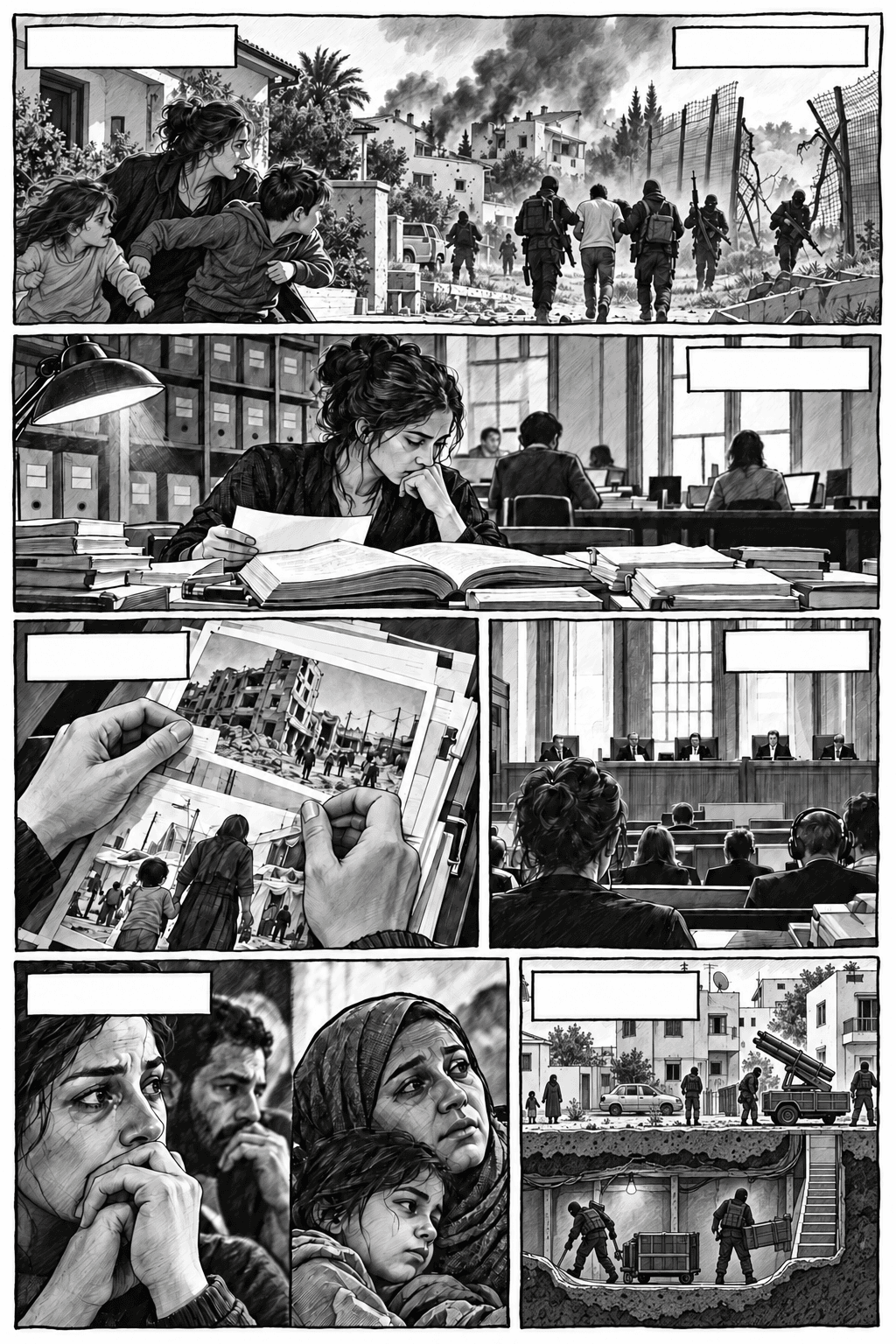
At dawn on 7 October 2023, civilians flee an Israeli border community as armed men enter; one hostage is led away toward Gaza. No injury is shown.
Israel launched its Gaza campaign after Hamas-led attacks killed Israeli civilians and took hostages. A UN investigation found war crimes, including deliberately attacking civilians and hostage-taking. During the war, Israel said its aims included defeating Hamas and returning the hostages. The IDF reported all living and deceased hostages had been returned by 26 January 2026.
A vaccination team works during a marked humanitarian pause; nearby, a family reads a military evacuation message.
During the 2024 polio campaign, Israel's COGAT said it facilitated area-specific pauses while Palestinian health authorities and partner agencies delivered vaccines. WHO reported 559,161 children reached in round one and 556,774 in round two; these separate round totals do not show how many unique children received both doses. Israel also said it issued evacuation warnings. OCHA reported in August 2024 that many displaced families were being sent to unsafe or overcrowded areas. Israel's wartime aims included defeating Hamas and returning hostages; all hostages were reported returned on 26 January 2026.
The reader weighs evidence of Hamas's military activity among civilians alongside Israel's separate obligations under the laws of war.
Multiple sources document tunnels beneath civilian structures, rocket launches near residential areas, and military use of some civilian locations. Such conduct can endanger civilians and complicate operations, but it does not make every nearby object a lawful target or remove Israel's duties. Each attack still requires a specific assessment of distinction, proportionality, and precautions.
What the evidence supports
As of 13 October 2026, the ICJ had not ruled that Israel is guilty or cleared it on the merits. The UN Commission of Inquiry's September 2025 report and Amnesty's December 2024 investigation concluded genocide occurred; Israel rejects the inference of genocidal intent. The ICJ case remains pending.
The UN Commission of Inquiry concluded on reasonable grounds that genocide occurred in Gaza. Amnesty's original investigation also reached a genocide conclusion. Neither report is an ICJ merits judgment.
The ICJ ordered provisional measures to protect rights asserted under the Genocide Convention while the case proceeds. The orders do not decide the merits.
The strongest response
Israel disputes genocidal intent. During the war, Israel said its objectives included defeating Hamas and returning the hostages; the IDF reported that all living and deceased hostages had been returned by 26 January 2026. These are Israel's stated aims and the IDF's status report, not independent proof of conduct or intent.
A high civilian death toll is grave evidence, but the treaty also requires a prohibited act and the specific intent to destroy a protected group. Deaths alone do not settle that element.
The strongest contextual argument in Israel's favor is: ‘Israel possessed the power to inflict far greater destruction had annihilation been its goal, yet agreed to area-specific humanitarian pauses during the 2024 polio campaign, helped enable a vaccination effort run by Palestinian health authorities and partner agencies, and issued evacuation warnings. During the war, Israel said its aims included defeating Hamas and returning the hostages; the IDF reported that all living and deceased hostages had been returned by 26 January 2026. These facts do not settle every allegation, but they directly contradict the claim that Israel sought to destroy Gaza’s population as such.’ WHO reported 559,161 children reached in round one and 556,774 in round two. These are separate round counts and do not establish how many unique children received both doses. This is a counterargument, not a finding: it weighs against an inference of total annihilation but does not conclusively answer whether Israel intended to destroy a protected group in part.
Hamas's use of civilian areas is supported by more than Israeli statements. The UN Commission's 2024 report records reports that armed groups built tunnels beneath civilian structures, used civilian structures for military purposes at times, and fired rockets near residential areas. The U.S. State Department's 2023 human-rights report says Hamas used civilian locations, including medical facilities, to launch rockets, store weapons, and hold hostages. U.S. defense officials also described an intelligence assessment that Hamas and Palestinian Islamic Jihad used some hospitals, including al-Shifa, to support military operations and hold hostages. The evidence is substantial across these sources, though public verification varies by site and some intelligence remains classified.
Using civilians to shield military objectives is prohibited, and operating from or near civilian places can endanger the population. None of this releases Israel from its duties to distinguish civilians from combatants, assess proportionality, and take feasible precautions. Each claimed military target and attack still needs evidence-based, incident-specific review.
Israel says it issued evacuation warnings, according to its official account. OCHA reported in August 2024 that repeated displacement sent families to unsafe or overcrowded destinations. A warning is relevant evidence of precautions; by itself it does not establish a safe evacuation or settle whether an attack was lawful.
Israel has objected to the Commission's mandate. Separately, Israel and some ICJ judges have criticized the framing or interim reasoning in court proceedings. Read those critiques beside the record; none by itself disproves the reports' evidence.
What remains open
How should the evidence of prohibited acts, official statements, and patterns of conduct be weighed against Israel's stated military objectives? That is central to the disputed intent question.
As of 13 October 2026, the ICJ docket's latest listed development was Colombia's 22 September withdrawal of its intervention declaration. The merits remain pending; the Court's 21 May 2026 order set South Africa's Reply deadline at 22 November 2027 and Israel's Rejoinder deadline at 22 May 2029.
The ICJ is a judicial organ. The UN Human Rights Council is a political intergovernmental body, and its Commission of Inquiry is an investigative body with a specific mandate. Their roles and findings should not be merged.
The Commission also investigated Hamas; that does not by itself prove every separate finding impartial. Read its mandate, methods, Israeli objections, dissenting opinions, and underlying evidence together.
Who made these findings?
Read the institution and the record
A court ruling, an advisory opinion, an investigative report, a treaty, and a government response have different roles. The notes identify which one you are reading and what it did not decide.
Source notes
Primary records and original investigations are linked directly. Notes describe the source's role and limits; they do not ask you to accept its conclusions without reading.
- G1
International Committee of the Red Cross treaty database · Treaty text
Convention on the Prevention and Punishment of the Crime of Genocide, Article II ↗
Requires one of the listed acts and intent to destroy a protected national, ethnic, racial, or religious group, in whole or in part.
- G2
International Court of Justice · Court docket and provisional orders
South Africa v. Israel case docket ↗
As checked on 13 October 2026, the case docket showed no final merits judgment. Its latest listed case development was Colombia's 22 September 2026 withdrawal of its intervention declaration. Provisional measures are not a final merits judgment on genocide.
- G3
International Court of Justice · Procedural order
ICJ order of 21 May 2026 on written pleadings ↗
Sets South Africa's Reply deadline as 22 November 2027 and Israel's Rejoinder deadline as 22 May 2029. It does not decide the merits.
- G4
UN Independent International Commission of Inquiry · Investigative report
A/HRC/60/CRP.3: legal analysis of genocide in Gaza (2025) ↗
The 16 September 2025 report covers Gaza from 7 October 2023 through 31 July 2025. The Commission concluded on reasonable grounds that genocide had occurred. This is an investigation finding, not an ICJ judgment.
- G5
Amnesty International · Original NGO investigation
Amnesty International's 2024 Gaza investigation ↗
Concluded that Israel committed genocide in Gaza. This is an NGO investigation, not a court judgment.
- G6
Government of Israel · Government position
Israeli Deputy Attorney General remarks, 7 October 2026 ↗
In remarks on 7 October 2026, Israel's Deputy Attorney General called the genocide allegation baseless and criticized the proceedings. This is an official party position, not independent proof of intent or conduct.
- G7
UN Independent International Commission of Inquiry · Investigative report
A/HRC/56/CRP.3: 7 October attacks investigation ↗
Found that Hamas and other Palestinian armed groups committed war crimes on 7 October, including intentionally directing attacks against civilians, killings, and hostage-taking. It does not decide Israel's separate obligations in Gaza.
- G8
World Health Organization and UNICEF · Campaign report
Second round of Gaza polio campaign completed, 6 November 2024 ↗
WHO and UNICEF reported 559,161 children reached in the first round and 556,774 in the second. These are separate round counts; they do not establish how many unique children received both doses. Palestinian health authorities and partners delivered the campaign. The 2024 campaign used area-specific humanitarian pauses and faced access constraints in northern Gaza.
- G9
Israel Defense Forces · Party account
The War Against Hamas: Israel's stated military objectives and warnings ↗
Describes Israel's wartime objectives, including defeating Hamas and returning hostages, and its use of warnings through several channels. These are historical statements and Israel's account; the issuance of a warning alone does not prove it was effective or that an attack was lawful. The IDF reported all hostages returned on 26 January 2026 (G14).
- G10
UN Office for the Coordination of Humanitarian Affairs · Humanitarian assessment
OCHA: Mass evacuations in Gaza choke survival and severely constrain aid operations ↗
Documents repeated evacuation orders, multiple displacement, and unsafe or overcrowded destinations. Read alongside Israel's record of warnings; warnings do not establish that evacuation was safe, feasible, or sufficient to protect civilians.
- G11
UN Independent International Commission of Inquiry · Investigative report
A/HRC/56/CRP.4: detailed findings on military operations in Gaza ↗
The Commission records reports that armed groups built tunnels under civilian structures, used civilian structures for military purposes at times, and fired rockets near residential areas, putting civilians at risk. It could not independently verify all evidence presented by Israel. It stresses that Israel's duties to distinguish, assess proportionality, and take precautions remain binding regardless of the other side's conduct.
- G12
U.S. Department of State · Government human-rights report
U.S. State Department 2023 human-rights report: West Bank and Gaza ↗
Reports that Hamas used civilian population centers and locations, including medical facilities, to launch rockets, store weapons, and hold hostages. Summarizes reported evidence; it is not a court finding on every site or incident.
- G13
U.S. Department of Defense · Intelligence assessment described by officials
U.S. Department of Defense briefing on hospital-use intelligence, 21 November 2023 ↗
U.S. officials said the intelligence community assessed that Hamas and Palestinian Islamic Jihad used some Gaza hospitals, including al-Shifa, to conceal or support military operations and hold hostages. The briefing did not disclose the intelligence's sourcing, and the underlying material was not made public in full; readers cannot independently verify every detail.
- G14
Israel Defense Forces · Official status announcement
IDF: all living and deceased hostages returned, 26 January 2026 ↗
The IDF announced on 26 January 2026 that all living and deceased hostages had been returned from Gaza. This dates the end of that stated wartime objective; it does not establish Israel's intent or the lawfulness of military conduct.
- G15
Israel Defense Forces / COGAT · Party account of humanitarian coordination
IDF/COGAT: second Gaza polio vaccination campaign, 6 November 2024 ↗
COGAT says it facilitated tactical humanitarian pauses and coordinated with WHO and UNICEF during the second campaign. This documents Israel's account of its role; WHO and UNICEF provide the round-specific vaccination figures in G8.
- G16
World Health Organization · Campaign results report
WHO: response in the occupied Palestinian territory, April–December 2024 ↗
Reports 559,161 children reached in round one and 556,774 in round two, and describes the campaign as organized and implemented by the Palestinian Ministry of Health, WHO, UNICEF, UNRWA, and partners during agreed humanitarian pauses. Round counts are separate and do not establish the number of unique children who received both doses.
- B1
International Court of Justice · Institutional description
The International Court of Justice ↗
Explains the Court's judicial role and structure. The ICJ is distinct from the Human Rights Council and its Commission of Inquiry.
- B2
UN Human Rights Council · Resolution and mandate
Human Rights Council resolution S-30/1 and Commission mandate ↗
Records the creation and mandate of the continuing Commission of Inquiry. The Council is an intergovernmental body; the Commission is investigative.
- B3
UN Human Rights Council · Institutional report
Human Rights Council agenda item 7 report (2024) ↗
Documents the standing agenda item on Palestine and other occupied Arab territories. This structural fact alone does not prove that an individual finding is false.
- B4
Government of Israel, Geneva mission · Party position
Israel's objection to the Commission of Inquiry mandate (2025) ↗
Israel argues that the continuing mandate singles it out and is too broad. This is Israel's objection, not an independent finding of bias.
- B5
Government of Israel · Party position
Israel's statement on the ICJ annual report (2025) ↗
Criticizes political use of ICJ proceedings and interim measures. It presents Israel's argument, not an independent conclusion about the Court.
- B6
International Court of Justice · Court opinion and response to objections
ICJ advisory opinion on the Occupied Palestinian Territory (2024) ↗
Records objections about the request's framing and the Court's reasoning for proceeding. Read alongside the separate dissent and Israel's position.
- B7
International Court of Justice, dissenting opinion · Judicial dissent
Vice-President Sebutinde's dissent (2024) ↗
Argues that the request and record were one-sided and insufficiently addressed competing claims. A dissent, not the Court's majority holding.
- B8
International Court of Justice, dissenting opinion · Judicial dissent
Judge ad hoc Barak's dissent to the May 2024 order ↗
Critiques the provisional-measures reasoning and emphasizes that the order did not establish genocidal intent. It is not a final merits judgment.
- B9
UN Independent International Commission of Inquiry · Investigative report
A/HRC/56/CRP.3: 7 October attacks investigation ↗
The Commission also investigated Hamas and other Palestinian armed groups and found war crimes on 7 October. That does not validate every separate finding about Israel.
- B10
International Court of Justice · Provisional-measures order
ICJ order of 26 January 2024 ↗
Records the interim decision and Israel's participation in the proceedings. It is not a final merits judgment.
- B11
Government of Israel · Party position and critique
Israeli government review of UN reporting (2026) ↗
Presents specific Israeli allegations about UN reporting. Each example should be checked against the original report and underlying evidence.